
Homage from France - Mayaka Nakagawa
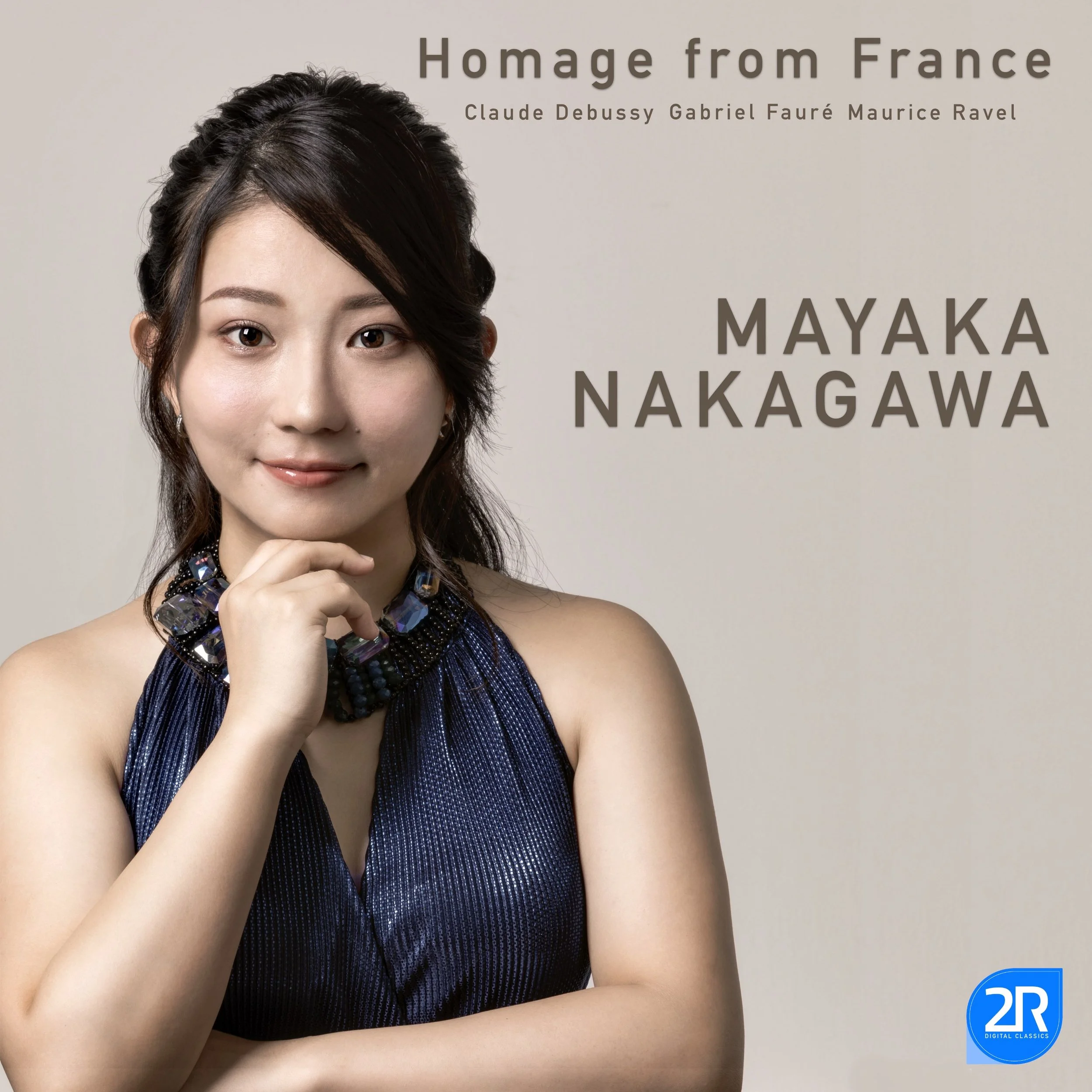
about album
Whenever I play the works gathered in this album, they awaken a peculiar and indescribable feeling in me: longing and nostalgia, warmth touched by melancholy, and a quiet sense of joy. It is a complex feeling that cannot be captured in a single word.
For me, playing music is also an act of imagination—an attempt to reach places and times I have never known. I imagine places I have never visited, times I have never experienced—in other words, worlds that existed beyond the time and space in which I myself exist—and I listen to them with what I might call an inner ear, trying little by little to experience them for myself.
I find one of the great attractions of art in this gaze toward the distant.
This sense of imagination is particularly vivid in Debussy's music. In Estampes, a fascination with distant cultures and landscapes is transformed into sound through his own sensibility. Rather than simply imitating other cultures, Debussy seems to have sublimated the impressions he had gained from them into music, reshaping them through the language of his own musical imagination.
I am also drawn to the title Deux Arabesques. An arabesque, with its intertwining and flowing lines and ornamental patterns, suggests something that continually unfolds and transforms. Music, too, allows one melodic line to meet another, overlap, flow, and change shape as it moves forward. There is almost a sense of looking anew at traditions that people have found beautiful for centuries, through the sensibility of another age.
This fluid sense of ornamentation seems to continue into Fauré's Impromptu No. 5, Op. 102 as well, where sixteenth notes flow throughout the piece. They never suggest mere virtuosity or restlessness. Instead, always within the music's natural, continuous flow, longing appears and gives way to resignation; warmth intensifies, only to suddenly recede. These fleeting changes of emotion may be impulsive, yet they never feel heavy; they remain fresh, delicate, and light. There is something deeply compelling to me in this feeling of reaching for something that has already begun to slip away, only to pursue it again and again.
Ravel's music inevitably leads me to reflect more deeply on our connection with the past.
Sonatine and Le Tombeau de Couperin evoke the traditions of early French music and dance, the Baroque suite, and even the forms of Classicism. Yet what we hear in these works is never simply the past itself. Ravel inherits older forms and aesthetic ideals, but gives them new life through his own harmony, sonority, colour, rhythm, and individual voice.
Ravel is said to have remarked: “Take a model, imitate it. If you have something to say, your personality will reveal itself most clearly in your unconscious infidelity.”
I feel a deep affinity with this idea. To respect something does not, I believe, mean simply reproducing it. It means looking closely, listening, and receiving it in one's own way—and, while preserving that respect, discovering a new form for it within oneself.
And perhaps this applies not only to music, but also to different cultures, to worlds we have yet to encounter, and to each individual work of art.
For me, the title Homage is therefore not simply an act of paying tribute to one particular thing. It is the act of turning one's gaze toward something distant; trying to understand its beauty, and carrying what one receives from it into a new form within oneself, while holding that existence in respect.
I feel that this attitude itself can be an hommage. And as a performer, I find myself looking again at what they have left behind, receiving their voices through my own ears and my own heart.
Perhaps this process is a quiet dialogue between past and present, between distant places and the person I am here and now.
Debussy, Fauré, Ravel.
Their music was born at different moments in history, and each of them looked at the world in a different way. Yet when I encounter their music, I cannot help but feel the beauty of a distinctly human form of creativity: the impulse to look toward something distant, to allow it to inspire us, and to transform that inspiration into our own expression.
Perhaps the nostalgia I feel in this music is not nostalgia for something I have actually known. It is something that seems entirely new, yet lies at the end of a long historical path. Something distant, yet somehow present in a corner of the heart.
A longing for something both far away and strangely close, the joy of reaching toward it, and the faint sadness of knowing that it can never be fully reached.
Perhaps it is precisely within this complexity that I find the beauty of this programme.
I hope that this album may offer you a moment to turn your own gaze toward something distant, and to share in that journey of imagination.
“Homage from France”
This is my way of paying tribute to what I receive from the music of France.
Mayaka Nakagawa
This album was recorded at the Yamaha Campus in Lesmo, with Yamaha CFX grand piano, for the 2R Digital Classics label.
Producers: Riccardo Radivo and Mayaka Nakagawa - 2R Digital Classics
Mixing & Mastering: Andrea Hideo Zorat
Program
Debussy, Estampes L.100
Debussy, Deux Arabesques L.66
Faurè, Impromptu Op. 102
Ravel, Sonatine, M. 40
Ravel, Le Tombeau de Couperin, M. 68
Video Promo Mayaka Nakagawa
Other CDs by the artist Mayaka Nakagawa
Recital (2023 2R Digital Classics)
My Favorite Chopin (2024 2R Digital Classics)
Deux Arabesques (2025 2R Digital Classics)